Some years ago Your Humble Narrator entered a contest on the late lamented online journal Topless Robot. "Tell us about your own ideal set of (currently non-existent) action figures," invited the contest organizer. I am not a big action figure collector, but at the time I had just finished re-watching a certain classic BBC series, and noticing how often very talented British TV actors wind up taking second-string (and occasionally leading) roles in SF and fantasy movies. This contest submission grew out of my post-viewing reveries. Sad to say, I didn't win, but I think the editor found my entry mildly amusing, and I suspect some of my readers will, too.
*
At the top of my (rather short) action-figure wish list (I wrote in 2009) stands a set of I, CLAUDIUS / Sci-Fi crossover
figures, in which each of the principal characters of the '70s BBC
series dually appears as a character played by the same actor in a SF series or movie. Examples would include:
Dual-action Augustus / Vultan figure, with optional speech
module - pull the string and he alternates between bellowing
"Quinctilius Varus, WHERE ARE MY EAGLES?" and
"Gordon's ALIVE?!"
Dual-action Livia / Reverend
Mother Gaius Helen Mohiam - each with its own unique methods of
poisoning your other action figures!
Sejanus
/ Jean-Luc Picard. Carries a death warrant
in one hand and a cup of Earl Grey in the other. Optional wheelchair for X-MEN crossover action.
Livilla /
Magenta action figure - can either shag your Sejanus (q.v.)
figure or swan about your Frank N. Furter figure dressed as a
maid.
Caligula / Cain figure. Accessories include
face-hugger alien figure and aborted fetus carved directly from
sister Drusilla's womb. Rosy-Fingered Dawn costume and play-set
sold separately!
And Macro / Maximilian Arturo figure -
comes with centurion's uniform, three-piece suit, vortex timer,
and extra helpings of smug. Also included: detachable limbs and
dwarf axeman costume for transformation into Gimli from LORD OF
THE RINGS.
I anticipated that this would inaugurate a whole
series of action figures based on BBC historical dramas and light
comedies. So far my vision has remained a fantasy, but the century is still young.
*
(In case you don't already know, Gaius Helen Mohiam
was Sian Phillips' character in DUNE, Magenta was the maid in
the ROCKY HORROR PICTURE SHOW, and Maximilian Arturo was the snotty
professor in the SLIDERS TV series, played by
Jonathan Rhys-Davies.)
Thursday, April 27, 2017
Wednesday, April 5, 2017
A Classic Game for Those Who Want to Hate Their Friends
I have played Diplomacy a dozen or so times since my D&D buddies taught it to me in 1982. It was one of the first historical games I had tried and probably helped spark my interest in history, as it dovetailed with my social studies class’s unit on the Russian Revolution and my history-buff mother’s introducing me to The Guns of August. By the time I reached college, however, I had learned what Margalit Fox observes in her 2013 obituary of Calhamer: Diplomacy rewards not the diplomatic player but the “aggressive” and treacherous one. I can’t say I was surprised to learn of its popularity with attorneys.
Later I got a hankering to play the game to the bitter end, and this inspired me to sign up for a postal game (1996-99) and a couple of play-by-email sessions. These taught me something postal players had discovered in the 1960s: if a Diplomacy match lasts long enough, the two lead players tend to develop a “stalemate line,” a chain of defensible territories blocking each other’s expansion. The game then turns into an inferior version of chess as the two leaders wait for someone to make a mistake, or for a surviving minor player to play kingmaker. Usually no-one cares to negotiate by this stage, after so many betrayals and broken alliances. A disappointing revelation, but I’m glad I finally found this out myself.
Allan Calhamer turns out to have been an interesting guy, of the genius/dilettente type Malcolm Gladwell described in Outliers. Educated at Harvard, a school nearly as fond of eccentric students as of rich ones, Calhamer attended law school but dropped out before getting his JD. He later worked as a corporate consultant, a park ranger, and a postman, and continued to develop games (none published) and amuse himself with mental puzzles. He didn’t leave a huge mark on American culture, but he did provide an unusual and engaging form of entertainment to quirky-bright people of all classes and many nations.
(First image above courtesy of Roger's Reviews and Boardgamegeek.com. Second image via Wikimedia Commons.)
Monday, March 27, 2017
Games That Don't Suck: Innovation
(For a list of games in this series, click here and scroll down.)
Civilization-building games tend toward massiveness. The 2002 board game version of Sid Meier’s Civilization included hundreds of plastic playing pieces and weighed about ten pounds. Seven Wonders provides a more elegant playing experience but still requires an array of equipment and at least a medium-sized table to play. Roll through the Ages has a compact footprint, but its clattering dice make it less than ideal for a crowded or quiet play environment. Few game designers have managed to create a civ-builder that is light, easy to set up, and covers (unlike RttA or 7 Wonders) the whole of human social development. Fewer still have developed a game that allows for deep play and a variety of strategies. Innovation may be the only offering that combines all of these advantages. The game has its quirks, but its persistent strengths keep my partner and I returning to it again and again, not just at home but on the road.
Innovation travels well. The
physical game is itself very compact: four small play mats (which experienced
players don’t need) and a deck of 110 playing cards. Five of these are special
achievements (see below); the rest are civilizational advances, which form the game’s
heart, soul, and musculature. Each of the 105 core cards bears
the name of the technology it represents; a description of its unique special power or
“dogma”; two to four symbols (castles, leaves, crowns, etc.) from a set of six,
representing the classes into which the dogmas fall; the card’s color, which
governs how many face-up cards one may have at a time; and the card’s age or era - Medieval, Renaissance, Industrial, and so forth.
Each player, on his/her turn, may perform two actions from this list: draw a new card, meld a card from their hand - that is, place it face-up in front of them - use a face-up card’s power or “dogma,” and/or collect a numbered achievement. Melded cards go onto one of five face-up stacks, sorted by color, and cover any previously-melded cards of that color beneath them. A covered card essentially represents an obsolete technology, and (unless it somehow returns to the top of the stack) one cannot use its dogma again. The new top card will generally have a dogma the player prefers to the old one, and often that card will belong to a later age, which is to say a higher-value draw pile. The age of a top card matters because it determines from which pile one draws new cards: one takes them from the draw pile corresponding to the latest (highest-value) top card in one’s play area. If that pile is empty one draws from the next-highest age. It pays to draw cards from later ages, as they usually have more uses than low-age cards.
Dogmas, or powers, represent the game’s core play elements. When used they allow a player to draw new cards, meld multiple cards from one’s hand, score cards from one’s hand or play area, or inflict damage on another player’s hand, play area, or score pile. Each dogma has a symbol associated with it that determines its power. A player uses all of the visible symbols of the appropriate type, from all the cards in his/her play area, to power a dogma.* The number of symbols used can strengthen the dogma’s effect. It also determines whether the dogma can affect other players. A demand (or attack), identified on the card by the boldface words “I demand,” affects only players who display fewer of the dogma’s associated symbols than the player making the demand. A non-demand dogma, on the other hand, may be shared by any other player with as many or more of the dogma’s associated symbols in his/her display. If another player does share the dogma, they use it themselves, and the active player then draws a card for each sharing player. Essentially, they have traded the use of one technology for the acquisition of another.
Each player, on his/her turn, may perform two actions from this list: draw a new card, meld a card from their hand - that is, place it face-up in front of them - use a face-up card’s power or “dogma,” and/or collect a numbered achievement. Melded cards go onto one of five face-up stacks, sorted by color, and cover any previously-melded cards of that color beneath them. A covered card essentially represents an obsolete technology, and (unless it somehow returns to the top of the stack) one cannot use its dogma again. The new top card will generally have a dogma the player prefers to the old one, and often that card will belong to a later age, which is to say a higher-value draw pile. The age of a top card matters because it determines from which pile one draws new cards: one takes them from the draw pile corresponding to the latest (highest-value) top card in one’s play area. If that pile is empty one draws from the next-highest age. It pays to draw cards from later ages, as they usually have more uses than low-age cards.
Dogmas, or powers, represent the game’s core play elements. When used they allow a player to draw new cards, meld multiple cards from one’s hand, score cards from one’s hand or play area, or inflict damage on another player’s hand, play area, or score pile. Each dogma has a symbol associated with it that determines its power. A player uses all of the visible symbols of the appropriate type, from all the cards in his/her play area, to power a dogma.* The number of symbols used can strengthen the dogma’s effect. It also determines whether the dogma can affect other players. A demand (or attack), identified on the card by the boldface words “I demand,” affects only players who display fewer of the dogma’s associated symbols than the player making the demand. A non-demand dogma, on the other hand, may be shared by any other player with as many or more of the dogma’s associated symbols in his/her display. If another player does share the dogma, they use it themselves, and the active player then draws a card for each sharing player. Essentially, they have traded the use of one technology for the acquisition of another.
In discussing dogma symbols,
I use the word “visible” deliberately. Normally, only can only use the symbols
on the top cards of one’s stacks to power dogmas. However, some dogmas let
players splay a stack of cards - spread them rightward, leftward, or upward, to
display the dogma symbols on the lower cards. Splays can dramatically increase
the number of visible symbols in one’s play area, especially upward splays
(most cards concentrate their symbols on their bottom edge). Splaying
represents civilizational investment or development: one is essentially
“bringing up” buried dogma symbols like seeds growing into mature plants.
In addition to acquiring and melding new cards, splaying card stacks, burying cards (a dogma action that lets one put cards at the bottom of a stack), and attacking other players, one can use some dogmas to score cards. To score, one takes a card from the top of the relevant draw pile (specified in the description of the dogma one used) and places it face-down in one’s score pile. A scored card is worth a number of points equal to its age - between 1 and 10 points. One may then use the score pile to purchase achievements, analogous to the Wonders one finds in other civilization-builder games. At the start of the game the players create a line of nine face-down cards from the first nine draw piles, which represent the “ordinary” achievements. Each costs five points times the achievement’s age, or from 5 to 45 points total. A player must have sufficient points in his/her score pile to buy the achievement and must spend an action to do so. Score piles are not depleted through the purchase of achievements, and achievements may not subsequently be taken from the player, though a bad result with the Nuclear Fission dogma might destroy them.
Innovation also includes five special achievements, which a player automatically acquires upon achieving their listed conditions: having three visible symbols of each of the six types, for example, or splaying all five of one’s stacks upward or rightward. One does not spend an action to acquire these specials. The first player to acquire a total of six achievements - five in a three-player game, four in a four-player game - wins the game. Everyone else reverts to drooling barbarism.
Actually, that’s not quite the only way to win Innovation. Some of the higher-age cards contain special victory conditions that fire off automatically when a player uses that card’s dogma. A player can win automatically with the Empiricism dogma, for instance, if s/he has at least 20 light-bulb symbols displayed in his/her play area. One might call this the “Rapture of the Nerds” (or Singularity) victory. Some dogmas let the player with the smallest score pile win – if, for instance, a combination of Software, A.I., and Robotics are ever in play. (Presumably, this sets off the Robot Apocalypse.) If the players somehow exhaust all ten era decks without someone winning through achievements, the player with the highest score takes the win.
In addition to acquiring and melding new cards, splaying card stacks, burying cards (a dogma action that lets one put cards at the bottom of a stack), and attacking other players, one can use some dogmas to score cards. To score, one takes a card from the top of the relevant draw pile (specified in the description of the dogma one used) and places it face-down in one’s score pile. A scored card is worth a number of points equal to its age - between 1 and 10 points. One may then use the score pile to purchase achievements, analogous to the Wonders one finds in other civilization-builder games. At the start of the game the players create a line of nine face-down cards from the first nine draw piles, which represent the “ordinary” achievements. Each costs five points times the achievement’s age, or from 5 to 45 points total. A player must have sufficient points in his/her score pile to buy the achievement and must spend an action to do so. Score piles are not depleted through the purchase of achievements, and achievements may not subsequently be taken from the player, though a bad result with the Nuclear Fission dogma might destroy them.
Innovation also includes five special achievements, which a player automatically acquires upon achieving their listed conditions: having three visible symbols of each of the six types, for example, or splaying all five of one’s stacks upward or rightward. One does not spend an action to acquire these specials. The first player to acquire a total of six achievements - five in a three-player game, four in a four-player game - wins the game. Everyone else reverts to drooling barbarism.
Actually, that’s not quite the only way to win Innovation. Some of the higher-age cards contain special victory conditions that fire off automatically when a player uses that card’s dogma. A player can win automatically with the Empiricism dogma, for instance, if s/he has at least 20 light-bulb symbols displayed in his/her play area. One might call this the “Rapture of the Nerds” (or Singularity) victory. Some dogmas let the player with the smallest score pile win – if, for instance, a combination of Software, A.I., and Robotics are ever in play. (Presumably, this sets off the Robot Apocalypse.) If the players somehow exhaust all ten era decks without someone winning through achievements, the player with the highest score takes the win.
Innovation sounds like an
exhaustingly difficult game to learn. It is not a good offering for
beginners, who may find its terminology off-putting and who may struggle to interpret some of the cards. (The manufacturer has a free FAQ file online covering all of the cards in the base game.) Much of the complexity of the game, however, lies in its strategy
and the choices players can make. As in
other civilization-building games, Innovation requires players constantly to
balance different resources and adjust their strategies to take advantage of
opportunities. Players might work on building up their civilization’s “stock”
of symbols, by finding dogmas that splay their stacks and melding new cards to
those stacks. This can take time away, however, from adding cards to their
score piles and using the points to buy achievements. Building up a score pile,
in turn, can distract players from acquiring the combinations of symbols or
actions that let them acquire special achievements. Focusing on one's score pile and achievements takes time away from advancing up the "tech ladder" with dogmas that let one draw and/or place cards from later ages. Players must also keep an
eye on each other's symbol “strength,” since this allows their rivals to “borrow”
valuable dogmas or (worse) to attack their civilizations. There are a lot of choices, and none of them are trivial.
I have played Innovation nearly one hundred times, most of them with just my significant other, and no two of our games have been the same. Every game has commanded our attention and all of our mental faculties. The only tacit agreement we have with one another is not to trigger a nuclear war. Nuclear war, we have decided, is kid’s stuff.
Real gamers always go for the robot apocalypse.
I have played Innovation nearly one hundred times, most of them with just my significant other, and no two of our games have been the same. Every game has commanded our attention and all of our mental faculties. The only tacit agreement we have with one another is not to trigger a nuclear war. Nuclear war, we have decided, is kid’s stuff.
Real gamers always go for the robot apocalypse.
* One can thus have a six-leaf dogma, a nine-factory dogma, and so forth, even
if the dogma’s own card has only one or two of that symbol.
Sunday, February 26, 2017
Dystopia and Dissolution: Totalitarian Fragility in Orwell's Nineteen Eighty-Four
(Spoilers ahead, in case you were wondering.)
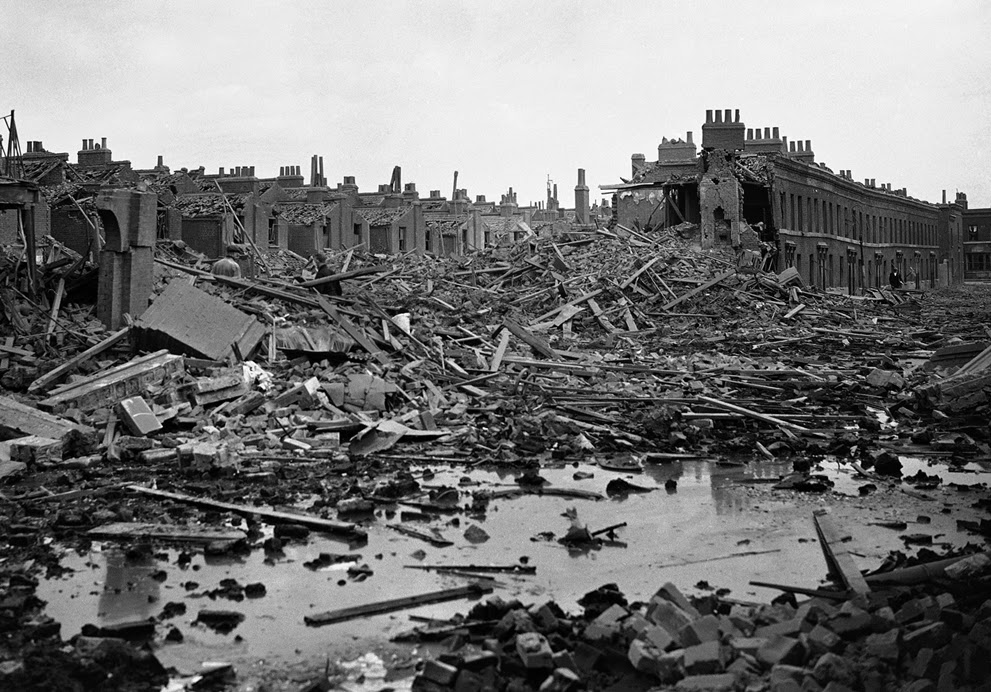
For all its reputation as a masterpiece of dystopian horror, a vision of an endless and immutable nightmare future, George Orwell’s 1984 presents the reader with a remarkably fragile totalitarian society. Earlier dystopias, like Zamyatin’s We and Huxley’s Brave New World, posited a future of gleaming, hard-edged cities and humanity enslaved by super-science. Orwell instead set his novel in a rubble-strewn future London, a grubby half-ruin of decaying buildings and clogged drains, its people worn down by long working hours and bad food. The main character, Winston Smith, reflects that
In any time he could accurately remember, there had never been quite enough to eat, one had never had socks or underclothes that were not full of holes, furniture had always been battered and rickety, rooms under-heated, Tube trains crowded, houses falling to pieces, bread dark-colored, tea a rarity, coffee filthy-tasting, cigarettes insufficient - nothing cheap and plentiful except synthetic gin. (Folio Society edition, 2014, pp. 56-57).
Scientific progress, meanwhile, had halted at a 1945 level, with a few exceptions (like the telescreen) that support the state’s surveillance regime. One expects, when Smith finally falls into the clutches of the Ministry of Love, that Oceania will turn out to have some advanced interrogation and brainwashing techniques, but no such luck. Lenin’s Cheka would have found the Thought Police’s methods familiar: the ever-burning electric light, the rubber truncheon, the use of pain and disorientation to break the victim. Even the most fearsome dungeons of Orwell's dystopia are worn and old.
Critics have suggested that Orwell based much of 1984 on his real-life experiences, modeling Winston Smith’s London after the fraying, rubble-strewn city of the 1940s. I suspect G.O. found it easier to set his novel in a copy of WWII-era London than to imagine something closer to Metropolis. Nonetheless, Orwell’s experiences and memories of England predated the war, and if he had not wanted to envision a more “futuristic” setting he could still have given Oceania the same standard of living, or at least the same aesthetics, as Britain in the 1920s or ‘30s. He chose instead to create a decrepit dystopia, one fully capable of tormenting its subjects but perhaps running out of time to do so.
Orwell’s decision to make Oceania a stagnant wreck provides some insight into his actual thinking about contemporary totalitarian states: they could not last. The two essays he included in the text, “The Theory and Practice of Oligarchical Collectivism” and “The Principles of Newspeak,” comprise additional clues. Thomas Pynchon once observed that 1984 ended not with Winston Smith’s final conversion but with the Newspeak essay, which Orwell’s dispassionate narrator wrote in the past tense and the subjunctive mood. Newspeak, s/he tells us, “would have superseded Oldspeak [pre-Revolutionary English]” by 2050 - not “did supersede” or “will supersede.” The essayist does not use Newspeak and thus writes to us from a non- or post-Oceanian future, perhaps a worse one in some ways but at least a future in which independent thought is possible.
“Oligarchical Collectivism” paints a darker picture, describing a world of ingenious totalitarian bureaucrats and stable super-states. We learn during Smith’s interrogation, however, that the Inner Party actually wrote the whole thing, and thus most or all of it consists of lies and propaganda. Moreover, the essay borrows heavily from James Burnham, a twentieth-century political scientist whom Orwell once admired and later severely criticized. Burnham, like the authors of “Oligarchical Collectivism,” argued that twentieth-century slave states like Nazi Germany or Soviet Russia enjoyed a degree of strength, cohesion, and dynamism unavailable to democracies. Orwell, in his essay on “James Burnham and the Managerial Revolution," strongly disagreed:
It is too early to say in just what way the Russian regime will destroy itself…but at any rate, [it]…will either democratize itself, or it will perish. The huge, invincible, everlasting slave empire of which Burnham appears to dream will not be established, or…will not endure, because slavery is no longer a stable basis for human society. (Collected Essays, Journalism, and Letters (Nonpareil Books, 1968/2000), 4: 180.)
Orwell gave the Soviet Union until 1960 to liberalize or collapse. Indeed, the communists did both: the USSR liberalized slightly under Khrushchev, and decayed rapidly under Brezhnev. Soviet citizens of the 1980s would have found Winston Smith’s milieu oddly familiar, if rather more repressive than their own society.
George Orwell died shortly after finishing his last novel, and had no plans for a sequel to 1984. He did leave hints about how the people of a post-Ingsoc Britain would live. Julia, one of the few young characters in the novel, pursues material pleasures like real coffee and illicit sex, along with the anarchic joy that comes from breaking the law. The working-class “proles,” the group in whom Smith sees the only chance for a better future, share Julia’s desire for humble amusements: cheap beer, the lottery, child-rearing, singing. They also recall the common decencies of the old world, protecting Smith from an incoming rocket and toasting his health when he buys one of them a drink. Winston and Julia forsake these decencies when they join the alleged resistance movement, which eventually turns out to be a trap. One can read 1984 not only as a warning about the future but a moral fable, urging us to hold on to those things that keep us human, rather than forsaking them for power or some imagined greater good. Preserving brotherhood, good manners, and the happiness of small pleasures, are more effective ways to resist a totalitarian nightmare than the bomb and the gun.
*
(London photo above via historicalphotosdaily.blogspot.com.)
Thursday, January 26, 2017
Worlds in Abundance: After 40 Years, Traveller Remains Compelling
Those of us who grew up in the era of tabletop role-playing games often find that the scenes and characters those games created occupy more of our mental landscape than any book or show. Teachers know that students learn more effectively when they actively engage with the material they study; a similar principle applies here. We may find Lord of the Rings or Star Wars exciting and moving, but we are likelier to remember worlds that we have manipulated and developed ourselves. I’ve written before about one of these peculiarly resonant gaming worlds, that of Dungeons & Dragons. Many of its players can remember fond hours spent “rolling up” characters, sketching dungeons and ruins on graph paper, and poring through bestiaries of fantastic creatures and compendia of magical treasures.
For me, the gaming milieu that had the strongest presence in my imaginative life wasn’t Gary Gygax’s eccentric fantasy world but Marc Miller’s eclectic science-fiction game Traveller. First published in 1977, it first caught my attention in elementary school, and I continued to play it, off and on, through graduate school. Traveller was no great shakes as an actual game. Its first edition became mildly famous as “the game where you can die during character generation,” and the rules for starships and space combat grew so complicated that by the second edition one needed a computer even to design spacecraft. Traveller’s appeal lay, rather, in its setting, a vivid melange of space opera (typified by the “Third Imperium,” with its nobles and distant emperor), well-developed alien species, low-technology personal combat a la Dune or Firefly, and grubby adventures for PCs, usually involving larceny, spying, smuggling, or some other shady activity. Principal designer Marc Miller borrowed heavily from Earth’s history and from an array of middle-shelf sci-fi novels, notably E.C. Tubb’s Dumarest series and H. Beam Piper’s Star Viking. Later designers added in space battle scenarios derived from STAR WARS, elements of Larry Niven’s Known Space novels, and a scenario or two based on the film ALIEN.
This sounds like it should have become an unholy mess, but Miller and his colleagues made it work, partly by leaving a lot of details up to the gamemaster, partly by allowing adventures to occur on many different physical scales. As an adventurer one could salvage abandoned spaceships, explore alien ruins, fight mercenary battles for interstellar corporations, carry (or smuggle) exotic cargoes from starport to starport, or explore backwater worlds off the main travel routes. Those worlds comprised Traveller’s most compelling cast of characters. The game provided simple rules for determining the basic features (atmosphere, population, etc.) of alien worlds, and allowed GMs and designers to flesh out those numbers into dozens of compelling adventure settings. There was Azun, whose small landmass held 26 billion people, crowded into towering arcologies; Bellerophon, an ocean world harboring the island-sized daghadasi (and the nomads who hunted them); Dinom, a vacuum planet of sun-baked flatlands and rebellious mining cities; Mithril, a barely habitable iceball with short-lived “ephemeral glades” of flora; the wildernesses of Pagliacci, the pitchblende mines of Newcomb, the reclusive nobility of Sainte Foy, and many others. All suggested a universe of fractal complexity, a galactic-level civilization that retained its variety and dynamism at whatever magnification one viewed it. And since Traveller was a role-playing game, authors like Miller, Loren Wiseman, and John M. Ford presented these worlds as places that the reader (or his/her 57th-century surrogate), not some improbably heroic character from someone else’s story, could explore. This was a compelling offer to one who wanted to travel, wanted to escape the gray and restrictive world of home and school, but had no physical or financial means to do so.
More on some of Traveller’s many worlds in future blog posts, I suspect.
(Image above from stargazersworld.com, which holds the rights thereto.)
Subscribe to:
Posts (Atom)