Sunday, February 26, 2017

Dystopia and Dissolution: Totalitarian Fragility in Orwell's Nineteen Eighty-Four


(Spoilers ahead, in case you were wondering.)

For all its reputation as a masterpiece of dystopian horror, a vision of an endless and immutable nightmare future, George Orwell’s 1984 presents the reader with a remarkably fragile totalitarian society. Earlier dystopias, like Zamyatin’s We and Huxley’s Brave New World, posited a future of gleaming, hard-edged cities and humanity enslaved by super-science. Orwell instead set his novel in a rubble-strewn future London, a grubby half-ruin of decaying buildings and clogged drains, its people worn down by long working hours and bad food. The main character, Winston Smith, reflects that

In any time he could accurately remember, there had never been quite enough to eat, one had never had socks or underclothes that were not full of holes, furniture had always been battered and rickety, rooms under-heated, Tube trains crowded, houses falling to pieces, bread dark-colored, tea a rarity, coffee filthy-tasting, cigarettes insufficient - nothing cheap and plentiful except synthetic gin. (Folio Society edition, 2014, pp. 56-57).

Scientific progress, meanwhile, had halted at a 1945 level, with a few exceptions (like the telescreen) that support the state’s surveillance regime. One expects, when Smith finally falls into the clutches of the Ministry of Love, that Oceania will turn out to have some advanced interrogation and brainwashing techniques, but no such luck. Lenins Cheka would have found the Thought Police’s methods familiar: the ever-burning electric light, the rubber truncheon, the use of pain and disorientation to break the victim. Even the most fearsome dungeons of Orwell's dystopia are worn and old.
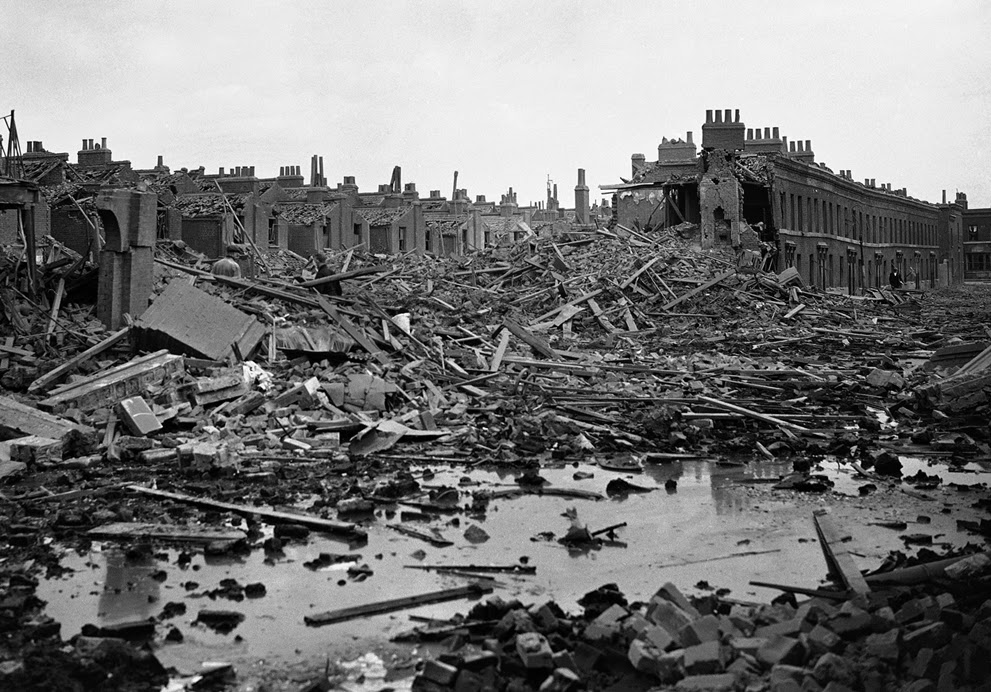
Critics have suggested that Orwell based much of 1984 on his real-life experiences, modeling Winston Smith’s London after the fraying, rubble-strewn city of the 1940s. I suspect G.O. found it easier to set his novel in a copy of WWII-era London than to imagine something closer to Metropolis. Nonetheless, Orwell’s experiences and memories of England predated the war, and if he had not wanted to envision a more “futuristic” setting he could still have given Oceania the same standard of living, or at least the same aesthetics, as Britain in the 1920s or ‘30s. He chose instead to create a decrepit dystopia, one fully capable of tormenting its subjects but perhaps running out of time to do so.

Orwell’s decision to make Oceania a stagnant wreck provides some insight into his actual thinking about contemporary totalitarian states: they could not last. The two essays he included in the text, “The Theory and Practice of Oligarchical Collectivism” and “The Principles of Newspeak,” comprise additional clues. Thomas Pynchon once observed that 1984 ended not with Winston Smith’s final conversion but with the Newspeak essay, which Orwell’s dispassionate narrator wrote in the past tense and the subjunctive mood. Newspeak, s/he tells us, “would have superseded Oldspeak [pre-Revolutionary English]” by 2050 - not “did supersede” or “will supersede.” The essayist does not use Newspeak and thus writes to us from a non- or post-Oceanian future, perhaps a worse one in some ways but at least a future in which independent thought is possible.

“Oligarchical Collectivism” paints a darker picture, describing a world of ingenious totalitarian bureaucrats and stable super-states. We learn during Smith’s interrogation, however, that the Inner Party actually wrote the whole thing, and thus most or all of it consists of lies and propaganda. Moreover, the essay borrows heavily from James Burnham, a twentieth-century political scientist whom Orwell once admired and later severely criticized. Burnham, like the authors of “Oligarchical Collectivism,” argued that twentieth-century slave states like Nazi Germany or Soviet Russia enjoyed a degree of strength, cohesion, and dynamism unavailable to democracies. Orwell, in his essay on “James Burnham and the Managerial Revolution," strongly disagreed:

It is too early to say in just what way the Russian regime will destroy itself…but at any rate, [it]…will either democratize itself, or it will perish. The huge, invincible, everlasting slave empire of which Burnham appears to dream will not be established, or…will not endure, because slavery is no longer a stable basis for human society. (Collected Essays, Journalism, and Letters (Nonpareil Books, 1968/2000), 4: 180.)

Orwell gave the Soviet Union until 1960 to liberalize or collapse. Indeed, the communists did both: the USSR liberalized slightly under Khrushchev, and decayed rapidly under Brezhnev. Soviet citizens of the 1980s would have found Winston Smith’s milieu oddly familiar, if rather more repressive than their own society.

George Orwell died shortly after finishing his last novel, and had no plans for a sequel to 1984. He did leave hints about how the people of a post-Ingsoc Britain would live. Julia, one of the few young characters in the novel, pursues material pleasures like real coffee and illicit sex, along with the anarchic joy that comes from breaking the law. The working-class “proles,” the group in whom Smith sees the only chance for a better future, share Julia’s desire for humble amusements: cheap beer, the lottery, child-rearing, singing. They also recall the common decencies of the old world, protecting Smith from an incoming rocket and toasting his health when he buys one of them a drink. Winston and Julia forsake these decencies when they join the alleged resistance movement, which eventually turns out to be a trap. One can read 1984 not only as a warning about the future but a moral fable, urging us to hold on to those things that keep us human, rather than forsaking them for power or some imagined greater good. Preserving brotherhood, good manners, and the happiness of small pleasures, are more effective ways to resist a totalitarian nightmare than the bomb and the gun. 

*

(London photo above via historicalphotosdaily.blogspot.com.)

Thursday, January 26, 2017

Worlds in Abundance: After 40 Years, Traveller Remains Compelling


Those of us who grew up in the era of tabletop role-playing games often find that the scenes and characters those games created occupy more of our mental landscape than any book or show. Teachers know that students learn more effectively when they actively engage with the material they study; a similar principle applies here. We may find Lord of the Rings or Star Wars exciting and moving, but we are likelier to remember worlds that we have manipulated and developed ourselves. I’ve written before about one of these peculiarly resonant gaming worlds, that of Dungeons & Dragons. Many of its players can remember fond hours spent “rolling up” characters, sketching dungeons and ruins on graph paper, and poring through bestiaries of fantastic creatures and compendia of magical treasures.

For me, the gaming milieu that had the strongest presence in my imaginative life wasn’t Gary Gygax’s eccentric fantasy world but Marc Miller’s eclectic science-fiction game Traveller. First published in 1977, it first caught my attention in elementary school, and I continued to play it, off and on, through graduate school. Traveller was no great shakes as an actual game. Its first edition became mildly famous as “the game where you can die during character generation,” and the rules for starships and space combat grew so complicated that by the second edition one needed a computer even to design spacecraft. Traveller’s appeal lay, rather, in its setting, a vivid melange of space opera (typified by the “Third Imperium,” with its nobles and distant emperor), well-developed alien species, low-technology personal combat a la Dune or Firefly, and grubby adventures for PCs, usually involving larceny, spying, smuggling, or some other shady activity. Principal designer Marc Miller borrowed heavily from Earth’s history and from an array of middle-shelf sci-fi novels, notably E.C. Tubb’s Dumarest series and H. Beam Piper’s Star Viking. Later designers added in space battle scenarios derived from STAR WARS, elements of Larry Niven’s Known Space novels, and a scenario or two based on the film ALIEN. 

This sounds like it should have become an unholy mess, but Miller and his colleagues made it work, partly by leaving a lot of details up to the gamemaster, partly by allowing adventures to occur on many different physical scales. As an adventurer one could salvage abandoned spaceships, explore alien ruins, fight mercenary battles for interstellar corporations, carry (or smuggle) exotic cargoes from starport to starport, or explore backwater worlds off the main travel routes. Those worlds comprised Traveller’s most compelling cast of characters. The game provided simple rules for determining the basic features (atmosphere, population, etc.) of alien worlds, and allowed GMs and designers to flesh out those numbers into dozens of compelling adventure settings. There was Azun, whose small landmass held 26 billion people, crowded into towering arcologies; Bellerophon, an ocean world harboring the island-sized daghadasi (and the nomads who hunted them); Dinom, a vacuum planet of sun-baked flatlands and rebellious mining cities; Mithril, a barely habitable iceball with short-lived “ephemeral glades” of flora; the wildernesses of Pagliacci, the pitchblende mines of Newcomb, the reclusive nobility of Sainte Foy, and many others. All suggested a universe of fractal complexity, a galactic-level civilization that retained its variety and dynamism at whatever magnification one viewed it. And since Traveller was a role-playing game, authors like Miller, Loren Wiseman, and John M. Ford presented these worlds as places that the reader (or his/her 57th-century surrogate), not some improbably heroic character from someone else’s story, could explore. This was a compelling offer to one who wanted to travel, wanted to escape the gray and restrictive world of home and school, but had no physical or financial means to do so.

More on some of Traveller’s many worlds in future blog posts, I suspect. 


(Image above from stargazersworld.com, which holds the rights thereto.)

Saturday, December 31, 2016

John Christopher's FIREBALL: Rome Endures, but at What Cost?

In my youth I rarely encountered the idea or practice of alternate history. The alt-history storytelling tradition remained an obscure subset of science fiction, with only a few prominent novels and stories to its credit. Many, in the 1980s, had gone out of print: I didn't find Ward Moore's Bring the Jubilee until I was 20, didn't read Keith Roberts's Pavane until grad school. The first volume of John Christopher's Fireball trilogy, which came out in America while I was in junior high, thus struck me with the force of revelation. Here was one of my favorite writers, experimenting with an obscure (to me) concept that bridged my growing interests in speculative fiction and history. How exciting!

The title of the trilogy, and of its first volume, referred to a fiery portal that flung the series' main characters, Brad and Simon, from 20th-century Britain to another world. Initially Brad (the viewpoint character) believed they had become lost in Britain's past, in the primitive and cruel Roman era of two millennia past. Separated from his cousin Simon, Brad was abducted by soldiers and sold into slavery as a gladiator. He failed at that bloody trade, was purchased and freed by a Christian patrician, and reunited with his companion from the twentieth century. Except...as Simon explained, he and Brad were still IN the twentieth century, just on an alternate timeline, an "If world," where a series of fourth-century reforms had prevented the Roman Empire from Christianizing or falling. Edward Gibbon would have been pleased.

Brad, however, didn't care for the new world; he considered it barbarous. Hyper-intelligent and very well-read - traits Simon found nearly insufferable - Brad decided to give technical aid to a Christian revolt against Rome, like an inverse Martin Padway from Lest Darkness Fall (or a strange alternate version of Martin from Christopher's Sword of the Spirits). In a nice twist, the Christian insurgents decide they only want Brad to teach them medieval military technology. This proves more than adequate to defeat Rome's ossified legions. Then, as an experienced reader of Christopher's novels could have predicted, the Christians begin building a new regime as cruel as the Romans'. Brad and Simon and some of their Roman friends decide to get out of Dodge, and with a small sailing ship they head for Brad's homeland: North America.

The second and third novels of the series, unfortunately, lack the creativity of the first, and fail to develop the main characters and their motives. What drives them in New Found Land is not personal interest but necessity. In this second volume, Brad and Simon find that much of America lies in a pre-Columbian slumber. The Algonquian (and, eventually, Californian) Indians they encounter seem friendly, but turn sullen and suspicious once the newcomers wear out their welcome. A Norse refugee community on Nantucket later offers to take the travelers in but turns out to have nefarious plans. The Aztecs, whose empire has expanded geographically but ossified culturally, show the companions a more benign indifference. In another nice twist, Brad and Simon and their friends become pelote players, which at the cost of many bruises and scrapes lets them put together enough wealth to resume their journey, ultimately (in the cousins' case) as far as the Pacific. Then they lose their momentum. Brad had hoped to find some sort of home in California (his home state in the "real world"), but found only strange Indians and wilderness. Christopher seemed on the verge of letting his characters fall into existential despair.

Then he recalled that he was writing young-adult fiction, and sent in some Chinese slavers to kidnap them across the Pacific. So begins volume three, Dragon Dance, the weakest part of the trilogy. Brad and Simon discover that the Chinese Empire is alive and well, albeit with a few technical changes, namely ocean-going junks and gunpowder weapons. More significantly, some high-ranking Han appear to have acquired magical, or rather psionic, powers: control of their biorhythms, longevity, mental suggestion and illusion, even a limited kind of weather control. (Okay, maybe some of this is just magic.) None of these new powers have altered the structure of Chinese society, which remains stuck in the real-world equivalent of the fifteenth century. Peasants and slaves support monks and nobles, and barbarians periodically knock at the northern gates. Brad and Simon do take part in a rebellion against the emperor, supplying the opposing sides (don't ask - an unconvincing romantic rivalry is involved) with primitive tanks and aircraft. In the end, though, the new tech cancels itself out, the revolt fails, and the boys track down the mysterious head of China's Mind-Control Monks, who offers to send them home. One closes the book with a bit of relief, if also regret that Christopher didn't have many more novels left in him.

By the time I reread the trilogy in college, I had learned a bit more about history, and realized that Christopher held a rather deterministic view of it. If an important event were to happen differently (e.g. Rome fails to fall), history itself would not change but grind to a halt. Empires and human societies change very little in the Fireball trilogy, despite five to fifteen centuries of divergent history. Even China, with its trans-Pacific connections and psi powers, not to mention civil wars and Otherworld interventions, tends toward a medieval steady-state. Compare this with the dynamic continuum of a tale like Bring the Jubilee, where a Union defeat in the Civil War produces a stripped and impoverished North, a rich and expansionist South, a slowdown in technological innovation, and even changes in Latin American and European history. In Ward Moore's view, changing one important historical event has ripple effects throughout the world, divergences that build with each passing decade. In Christopher's continuum, changing a major event causes the rest of the historical machine to break down. Brad and Simon's comparative listlessness in books two and three becomes easier to understand within this authorial theory of history. If no human institution can ever really change again, why should individuals pursue any lofty or selfless goal? The castaway cousins would perhaps have found more to motivate them in the milieu of Christopher's Tripods series.

Monday, November 21, 2016

Does Not Stephen Baxter Fill You with a Sense of Wonder?


Scifi readers appreciate good writing as much as anyone, but usually give it lower priority than what they call “a sense of wonder:” a writer’s ability to evoke the immensity of the universe, the deepness of time, the diversity and strangeness of extraterrestrial life. Fandom is not a literary society but a quasi-religious order, and what most of us want from our novels and movies and games is not esthetic pleasure but transcendence. We tolerate bad writing so long as its author can take us from our mundane lives and tell us of something sublime.

Kurt Vonnegut, who dabbled in science fiction but refused to acknowledge it, satirized scifi writers and fans with his character Kilgore Trout, a dismal writer with a head full of good ideas. In the real world, E.E. “Doc” Smith, inventor (more or less) of the galactic-war epic, wrote his outsized narratives in a painfully juvenile style. L. Ron Hubbard, author of more than a thousand books, crafted space operas (e.g. Battlefield Earth) whose stylistic crapulence matched their delusions of galactic grandeur. The British physicist Stephen Baxter, who began publishing science fiction in the 1980s, fit himself into the Smith-Hubbard-Trout tradition. His early stories and novels, now known as part of “the Xeelee universe,” sketched out a future history of trans-galactic scope. Baxter’s fictions suffered from numerous flaws: clumsy dialogue (“Does it not fill you with a sense of wonder?”), forgettable characters, and the inevitable continuity errors. Fanboys like myself still found these tales fascinating. Despite his mediocrity as a wordsmith Baxter created a milieu of immense scale and mystery, and his stories and novels crackled with ideas – aliens trying to manipulate Planck’s constant, spaceships powered by the primordial superforce, pilots who used black holes as traps, mega-structures woven from superstrings. They offered pleasure to anyone who enjoyed watching an educated and creative mind at work.

Baxter's initial run of Xeelee stories comprised four novels (Raft, Flux, Ring, and Timelike Infinity) and a score of short stories anthologized in Vacuum Diagrams. They described a future history that began in the 37th century and ended ten million years later. The first Space Age apparently ended in our own near future, as humanity turned its resources to repairing our own badly damaged planet. Once people resumed exploring the Solar System they discovered life everywhere, from the caverns beneath Mercury to the frozen wastes of Pluto. A century or two onward, as homo sapiens began creeping toward the nearer stars, they ran into more advanced alien races who conquered and degraded them: the group-minded Squeem and the huge, exotic Qax. (Baxter had little talent for alien names.) One of these conquests actually extended itself backward in time. The engineer Michael Poole, a recurrent character in Baxter's stories, constructed a wormhole time bridge to the fifty-fourth century, through which human rebels and alien warships chased one another. That they avoided a time paradox one may attribute both to their decision to fight in more remote parts of the Solar System, and to Baxter's lack of interest in describing a time paradox.

Through several lucky breaks humanity defeated its conquerors and acquired from them alien super-weapons and FTL space drives. A more militaristic and fanatical human society began colonizing the galaxy, only to run into an even more powerful alien race: the Xeelee. (Told you he was bad with names.) Neither could peacefully coexist with one another by now, and a long series of wars, extending to about 1 million CE, ensued. Human warships broke up planets, set off supernovas, flung neutron stars at their adversaries – this was the background of Flux, set on a pulsar that microscopic humans had colonized – and, in the later novel Exultant, used FTL causality loops to garner tactical intelligence. Seizing at last the Xeelee redoubt at the core of the Milky Way (ca 20-30,000 CE), humanity paused to regroup, but later empires sent warships to attack the superstructure that served as the focus of Xeelee civilization: Bolder's Ring. 

This was a giant exotic-matter matrix, thousands of light-years across, built by the Xeelee as a gateway to other universes. It served as a plot device in Baxter's early novel Raft, wherein a human warship fell through the Ring into a universe where gravity was one billion times stronger than in our own dimension. (The alternate universe, a realm of breathable gas clouds, floating trees, and retrograde human castaways, resembled the setting of Larry Niven's Integral Trees.) In the last of his initial Xeelee novels, Ring, Baxter revealed that the Xeelee had built the gateway not out of ambition but fear. They wanted to escape our universe because a dark-matter species, the “photino birds,” had colonized nearly all of the stars in our reality and were dramatically accelerating the stellar aging process. By 10 million CE, none would remain luminous enough to support life.

Longtime sci-fi fans will note that Baxter's future history resembles Olaf Stapleton's novel Star Maker, which continuously “pulled back the camera,” so to speak, to show increasingly large and sophisticated interstellar civilizations. The Xeelee universe employed a similar creative structure, but increased the drama of its stories by making these alien cultures progressively more advanced and threatening. Humans discovered Solar species as intelligent but less powerful than humans, interstellar societies capable of conquering Earth, an intergalactic race able to fight off even a Type III human civilization, and a universal race of energy predators whom no-one could fight. This allowed readers to appreciate the gradually escalating scale (in both space and time) of Baxter's speculations, even as he used the old-fashioned narrative framework of war and exploration to scaffold out the plot.

After a seven-year hiatus, Baxter returned to the Xeelee stories in 2003 with a trilogy of novels, “Destiny’s Children”*, and two more anthologies. Some of these usefully fleshed out episodes that had received little previous attention, like the Human-Xeelee wars (Exultant) or the traumatic Squeem conquest of Earth (“Remembrance”). Others, alas, tacked on ideas that seemed thematically incompatible with the earlier series. Coalescent posited a sisterhood of Romano-British gentry trying to preserve their culture after the fall of Rome, and eventually developing into a eusocial hive entity. (This was Baxter’s riff on Frank Herbert’s Hellstrom’s Hive.) “Starfall” recounted an interstellar war, fought at slower-than-light speeds, between an Earth-based interstellar empire and its rebel colonies. The “Old Earth” stories took place on a far-future Earth shielded from the photino-birds by a time field, one which caused time to flow at different rates at different elevations - very rapidly in the mountains, glacially slow in the lowlands. These weren’t necessarily bad tales (okay, I didn’t care for Coalescent), but they fit poorly with their predecessors. Some dealt competently with the concept of deep time, but none really evoked the transgalactic scope of novels like Ring or the diversity-of-intelligence theme of Baxter’s early stories. Mostly they just reminded me of a certain ‘70s TV character vaulting his motorcycle over a shark: interesting concept, but not really what we came here to see.

(Illustration above, of Spline** warships on the move, are from http://www.rhysy.net/Galleries/Xeelee/2.jpg and are copyrighted by Rhysy.)


* No relation to the band, presumably.

** A race of intelligent whale-like creatures who converted themselves into spacecraft and rented their services to other species. This is one of Baxter's better ideas; Douglas Adams would have liked it.